
Broad brushstrokes.
The importance of the telling detail.


As I’ve said, I read a lot of craft books. Hey, I have an obsessive personality, what are ya gonna do? For this reason, I have a hard time recalling where I picked up a piece of advice, even one that changed the way I write.
The Telling Detail
I’m going to guess this came from Oakley Hall’s book The Art and Craft of Novel Writing. But I dunno, and it doesn’t matter. When I first considered this craft point, whole rooms of lightbulbs went off in my head. Aha, this is why some books (and stories) bore me. They get too bogged down into describing things. Now, don’t get me wrong. Some classic writers like that fantasy guy, Tolkien, described every rock, bush, stream, and hair on a hobbit’s toe. And he did okay, right?
Sure, he did… then. But that was a long time ago, and fiction has changed. It’s not about shorter attention spans and video games, rock ‘n roll, and baggy pants that affected everything! Plus, old JRR could have cut a few of those rock descriptions. Buddy, it’s a rock, let’s get on with the story.
The concept behind the telling detail is to pick one thing that encapsulates all you need to know about a character. I realize while writing this, I said all types of description. And true, a lot of us could describe the moon less (looking at you C. Terlson), but what I’m really thinking about is character.
Admittedly, I’m a person who doesn’t really care what a character looks like, so take this with a shaker of salt. When I’m reading about hair colour, complexion, what type of plaid shirt or wingtip shoes a character is wearing, I get quickly to the “I just don’t care” stage. Some writers are great at just giving enough.
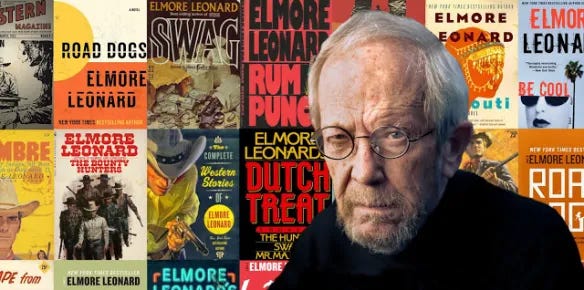
Elmore Leonard comes to mind.
Here are two of Elmo’s points on his philosophy of description:
Avoid the “Pause Button”: He argued that pausing the flow of the story simply to detail a character’s height, hair color, or clothing slows down the action and gives readers an excuse to skip ahead.
Point-of-View Characterization: If a character must be described, it should happen naturally from the point of view of another character. This reveals the observer’s attitude and voice at the same time.
As you can see, me and Mr. Leonard are on the same pace. Especially with the POV characterization.
Here is an example of his writing:
"He walks with his head cocked slightly to one side, as if he's about to ask you a question, and you better have the right answer. He looks, frankly, like he wants to fuck you up and like you've got it coming. He spent seven years in Lompoc, two in solitary confinement, and part of him is still there."
There is more than one telling detail in this description. But it is more about action than what the dude looks like. The cocked head, the wants to fuck you up look, the fact that part of him is still in solitary confinement.
Great stuff.
A reader once talked to me about how I describe characters. They focused on the pair of brothers in my novel Manistique. Their names were Francis and Emil, sons of Cecily, and nephews to Franko Toledo (Luke’s detective friend) These were small side characters, but important to the story. The reader said I had given them just enough broad brushstrokes to show who they are. I always liked that visual metaphor.
Here is the introduction to those two characters:
Before Franko was finished talking, she had appeared on the porch, carrying a platter with two large glasses of milk.
“These are Cecily’s boys. Francis and Emil.”
They nodded to us and went to their mother, each taking a glass and giving her a large hug.
“Francis will tell us what he found when he went back to the poker place,” Franko said.
“Did you both go together?” Sam asked.
They both took long gulps of milk at the same time.
“I should tell you, my nephew Francis is a man of few words. And I can’t recall the last time I heard Emil speak.”
So all we know here is that they both drink milk, and don’t talk much. Actually, Emil doesn’t speak at all. That’s it.
Later in the novel, Luke is in a diner with Emil (who still hasn’t spoke), and I use this telling detail to push forward another small stroke of his character.
Emil’s expression never changed, but at least he stopped staring at me. The food came, along with a pair of Sols for me and a large milk for Emil. Water dripped down the side of the ice-cold beers. The tacos were as good as any I’d had this side of the border, and close to the ones I ate daily in PV. The salsa was fresh and sharp, just the right amount of heat.
“Damn fine choice,” I said.
Emil chomped down on his pastor taco and gave a wink. It was the first time I’d seen him do it, and I wasn’t sure if the effect was comforting or chilling.
Hopefully you can see what I’m getting at. It’s not that drinking milk and being silent is all that Emil is about, but it creates a curiosity in the reader (one that hopefully will make them fill out the rest).
I often do this with small side characters. I’ve heard them described as “flat” and “round” characters. Not everyone in your book needs to be fully fleshed out like your main protagonists (round). And flat here does not meaning boring… it’s more that we don’t need to know the bartender’s whole backstory to appreciate him as a side character in a scene.

One more example, this one from Three Minute Hero. Mostly Harold comes across a young gas jockey in a nowhere station. This description also applies to the 2nd point of Leonard’s, where a character is described by another character’s POV. In this case, revealing what a grump-ass Harold is.
It took several roads, some backtracking, and a sign that the locals had been using for target practice to find what stood in for a main road out here. Harold drove the single-lane highway until he spied a gas station. There was no town in sight, only a big yellow orb that said Gas with most of the s peeled away.
“Fill ’er up. You got maps?”
“Yes sir. Whattya looking for?” The jockey was a tall pimply kid.
“Paris, France.”
“Excuse me?”
“What d’ya think I need, numbnuts? For this area.”
“Oh, oh, oh, for sure.”
Kid sputtered like Curly from the Stooges—no way was he getting laid anytime soon.
Harold spread the map on the hood and had the kid point out where they were. The kid pulled out a black marker and drew a fat circle around the nearest town.
“I’m gonna buy this map and you mark it up like that?”
Tall pimply kid (that’s generous description for me). But the part I love is Harold describing him as one of the Three Stooges, and then commenting on his lack of sexual prowess. This says lots about the jockey, but even more about Harold.
Like most (all) things in writing, it’s about a balance. And I don’t worry too much about these things in the drafting stage. At that point, I’m trying to figure out who these people are. But in edits is when I strip away. It’s not about minimalism, it’s more about creating strong characters with the best brushstrokes—the strokes that show who the character is. Ask yourself when you are describing what every person in your story is wearing… does this add to the overall narrative? Does this bring some sort of truth to who they are? Is it, um, kinda boring?
This stuff I think about. A lot.
Thanks for reading. As always, let me know what you think about this craft point.
And consider subscribing. All my content is always free, but if you want to throw me a couple of bucks, I promise I won’t spend it only on beer.
Good stuff. I should keep a log of my favorite telling details in novels I’ve read. I love the idea of seeing what a character looks like not from the static description you mention but how other characters look on them. One that comes to mind: “He looked as if he were genetically engineered to wear tracksuits and carry cash bundles in gym bags.” I read that and got a complete, detailed picture in my mind of that guy’s face and physique in a way a conventional rundown of his height, weight, body type and facial features never could.
Great post, agree on describing only the most important or telling details, especially for secondary characters. I always try to keep 2 things in mind when I'm writing tangential characters: 1. The Coen Brothers often make their secondary characters memorable, whether it's something they say, do, or look like. Who can forget Chet the bellboy in Barton Fink? 2. Chuck Palahniuk writes in his craft book about how your character should describe things/people in a way that reflects his/her own world view. For example, the main character shouldn't describe someone as "six feet tall," but more like "he was as long-legged as a ladder."