
F**k subtlety.
The heck with suspense.

Oh boy, I know I’m gonna get disagreement on this one. But finally understanding this “craft point” (it’s not a FUCKING RULE), changed the way I write, and for the better.
From my pal, Kurt V.
Give your readers as much information as possible as soon as possible. To heck with suspense. Readers should have such complete understanding of what is going on, where and why, that they could finish the story themselves, should cockroaches eat the last few pages.
It’s number 8 on Vonnegut’s much published list. When I first came across it, I didn’t understand. Because, you see: I believed that to be a true literary writer, you can’t give the reader everything. If you do, there is no mystery, you need obfuscation that first befuddles said reader, but then makes them realize, “Hey, this is some literary shit.”
I first read Vonnegut in college. In one sitting, I read Slaughterhouse Five (for a class.) It blew my mind because I didn’t know you were allowed to write like that. Where were the big words? Where was the rambling dense language that only hinted at what was going on? Wasn’t this guy supposed to be literary?
Fast forward a bunch of years to when I started writing. I wrote a problematic novel called Correction Line that was complex on purpose. The agent I finally got hated its complexity, and said so. He told me that many beginning novelists do this. They take on too much; their story, and even the number of characters, should be simpler. Now, he was selling Joe Hill books at the time, so I understand where he was coming from. But still… I wanted to be a literary writer with a capital L. So that meant, big words, complex sentences, vagueness… right?
The real lesson came from an interesting source. The Canadian writer Guy Vanderhaeghe has won some of our nation’s top literary awards, and in my opinion is truly one of Canada’s finest writers. He is also from my home province. So when I found out through some early internet sleuthing, including a chance encounter with Guy’s university roommate, I send him an email, and I had the balls to send him a complete story of mine. Like, a 5000-word one.
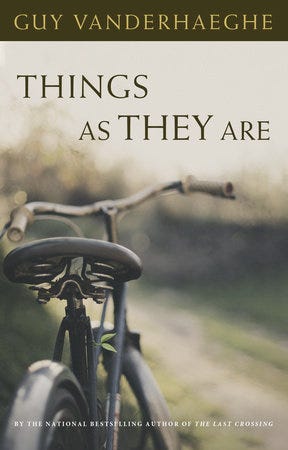
The short story I sent him would years later be folded into my novel Fall in One Day. As the time, I called it “Bare-Ass Bridge.”
To my delight (and shock), Guy wrote back. I think the next day.
Dear Craig Terlson:
Thank you for your kind words about my work; they are appreciated. I read your story with interest and amusement; it has many strong details, vivid humour and a fine sense of dialogue. You certainly can write. I don’t know if you are looking for suggestions or not, but I think the ending doesn’t quite achieve the effect I’m guessing you want. Something occurs during the “dunking”, the water becomes colder, clearer; something alters in the narrator’s perspective, I assume he has been transformed. What I’m struggling to say is the nature of the transformation isn’t evident.
… Since this is written in the first person, I assume that the narrator, in some sense, knows what has “happened” to him. His reluctance to divulge it to ensure that the ending is “subtle” somehow seems a tad tricky.
He wrote some other things, and we had a brief correspondence over the years.
But, having him say “You certainly can write”, was a phrase that carried me through the darkest years of rejection.
More importantly, his feedback taught me something. Yes, I knew what had happened to the main character… but I thought it would be more subtle (read: literary) to not divulge it. Mr. Vanderhaghe was subtly telling me, “It doesn’t work.” And he was right. It didn’t.
I can barely explain how much this changed the way I wrote; but it was an epiphany on the level of the transfiguration (go grab a Bible for the reference).
Somewhere along the way I read someone else, probably John Gardner, (who in the beginning of my writing was teaching me everything), and he said a similar thing. It came down to trusting your story to be strong enough that it can stand being told straight. That’s what Kurt meant in his rule. The hell with suspense. Tell the story. If it’s good enough, you don’t need subtlety. If you want to be vague because of some belief that this makes the story better, then you really gotta ask, “Is this story strong enough?” If not, why not?
People who ask me to read their work get these kind of notes from me all the time. I call it “grounding”. If I’m reading five pages of your work and I still don’t know what’s going on… that’s a problem. In a short story, if I’m reading a few paragraphs without understanding, that’s also a problem.
At the end of Vonnegut’s list he talks about Flannery O’Connor who broke almost every rule on the list. I believe he is reminding us that none of us are Flannery. But he’s also holding out the list for what it is, like the pirate’s code, more of a guideline.
But the thing is, I’ve read a lot of Flannery. And I always knew exactly what was going on in her stories. What they meant took some digging… but the stories were grounded. Same goes for writers like DeLillo or our pal Cormac (though, admittedly, I sometimes go WTF with McCarthy. But then the language carries me along. Spoiler: none of us are McCarthy either.)

So where do I end up?
In a recent convo with a writing pal, I said to them, “Love the idea, but it’s not on the page.” The hardest thing to do is to read your work like a reader experiences it. So often, things that are in our head, are not on the page. What can you do about that? Well, beta readers are good. Editors are golden. And even just stepping away from the work (for as long as you can stand it) will show you things.
Have you grounded your story? Does it flow, is it readable, does it carry the reader along? Writers like Vonnegut and even more so, George Saunders have shown me how using language in a simple direct way does not indicate lack of depth in the work. Some have called Saunders use of language “deceptively simple”… which shows how much we still believe work needs to be complex to have literary weight.
Don’t start sending me angry letters and naming authors who use complex language. I’ve read enough Umberto Eco to know that there are brilliant writers on both sides.
It’s more about asking yourself, to quote Guy, “why am I reluctant to divulge what is really going on?” Do I lack confidence that the work is strong enough to stand as it is? I ask myself this all the time. And I’m learning… slowly.
Thanks for reading - I look forward to your comments.
Please consider subscribing to this substack.
All my content is free, but I appreciate all the support I receive. Like, a lot.
Nothing annoys me more, in books or films, than the rabbit that suddenly jumps out of the hat. Typical of old style mysteries, the supposed sleight of hand where the author keeps a crucial clue behind the curtain and then "voila", case solved. I found it ridiculous when I was 12-years-old and I still do. Then there's what you're after: the author trying to be clever and muddying the waters, artificially. Red herrings can be fun, they're also hard to do well. Most of the time, that kind of story is just a silly game and the reader forgets it as soon as the book is closed. Now, I don't believe in putting everything flat under a hard light, especially when it comes to characters' motivations. People are complicated/confused in real life, why would they be different in fiction? Facts don't line up perfectly in reality either, when pieces fall neatly in place in fiction, I cry foul. And none of that is a valid excuse for convoluted/obscure/cryptic writing ...
I'm usually writing for my own enjoyment, then I think, "Hey, Somebody else might read this and not know what I know."