
Sending messages.
Not sure Goldwyn was right.


“If you want to send a message, call Western Union.”
This quote is often attributed to Sam Goldwyn, or sometimes Frank Capra, or maybe someone else. Doesn’t matter. This was a pointed message to those filmmakers who were trying to put their opinions (often political), into their movies. It’s a quote that gets used a lot - and misused.
I think about it whenever I read something that is trying to pound me over the head with an idea. I’ll admit, some of my early stories were didactic. So said a famous (to me) long rejection letter I got from a literary journal. You’ll never guess from where, so I’ll tell you: Canada! The land of the snooty magazine editors… to which I say, give me a fucking break. Sorry, sneaking up on a rant. But when a magazine editor tells me in two and a half pages (I shit you not), why they were not accepting my story… well, I might get a bit riled. He had the nerve to call the story didactic!!! After I looked up what the word meant, (hey, I only pretend to be smart,) I was like… um, maybe I was. So what?
Well, the so what is the Goldwyn quote.
There are some fantastic novelists who do capture certain ideas in their work. Robertson Davies made a career out of it (Fifth Business… the whole Deptford Trilogy). Don DeLillo is another one. But in both these cases the novels were full of beautiful language, authentic characters, and plots that moved… albeit slowly.
It’s when us lesser mortals try to cram an idea into our books that we often come up short. No one likes to be lectured, even more so in a book. But how do you write about the human condition without saying something about it?
What I’m dancing around here is my own political leanings. Follow me on social media, or read my posts here, and you can see why I might have a hard time getting across the U.S. border to visit friends (unless I pick up a burner phone from Saul Goodman… is he out of jail yet?)
I truly admire writer/journalists like Ellie Leonard and the awesome work her and other independent journalists are doing in exposing the absolute shit-show of a so-called government led by head-pedophile and Mr. Orange Cheeto himself. Myself, I comment on and support this work. But how, if ever, do these opinions enter into my work?
If we are aware of the world around us, and write from an authentic place, there's a very real possibility that our views will sneak into the work. I do believe the first job of a novelist is to entertain, and I will go out thinking that. But entertainment can be smart, and can be thought-provoking, and it can change minds.
I love when a novelist, or really any writer, changes the way I think. I’m still reeling (in a good way) from reading and reviewing Michael Pollan’s latest book A World Appears—A Journey into Consciousness. There are parts of the book that I really don’t understand, but I’m very okay with that. I know it is changing the way I think of things… notably, what does it mean to be sentient? Yes, it gets trippy. And I do sometimes, too (See parts of Samurai Bluegrass, and all of Bent Highway for proof of this.)
I guess I’m thinking a lot about this because when I read work from people like Ellie, I feel bad that I’m not contributing in my own way to exposing the crimes of politicians (and others.) But I do find that the world is sneaking into my somewhat fable-like world of Luke Fischer. One of my favourite writers and readers, Thomas Trang (who wrote the intro to the Surf City Acid Drop re-release), said this very interesting thing about the latest Fischer book, Sayulita Sucker:
Like I said, this book is a little different to the others. It is shorter and the only one that is solely set in Mexico. The reader might be tempted to think of Sayulita Sucker as a minor episodic entry in the Fischer oeuvre. Yeah, I just used the word oeuvre—correctly—in a crime fiction review. I also used “vicissitudes” in the paragraph above. Deal with it.
But…despite the novella length, this book might even be seen as a turning point in the series (provided there are more books coming). We start to see some of the real world creeping into this idyllic and idealised Xanadu south of the border, and it ain’t pretty.
In a striking image captured on the book’s cover, Fischer grapples with the darkness
that surrounds him and no amount of picturesque Mexican sunsets, pretty senoritas or Pacificos can keep it at bay, a violence that “swallowed humanity and spat it out like
a lone surfboard by the rocks.”
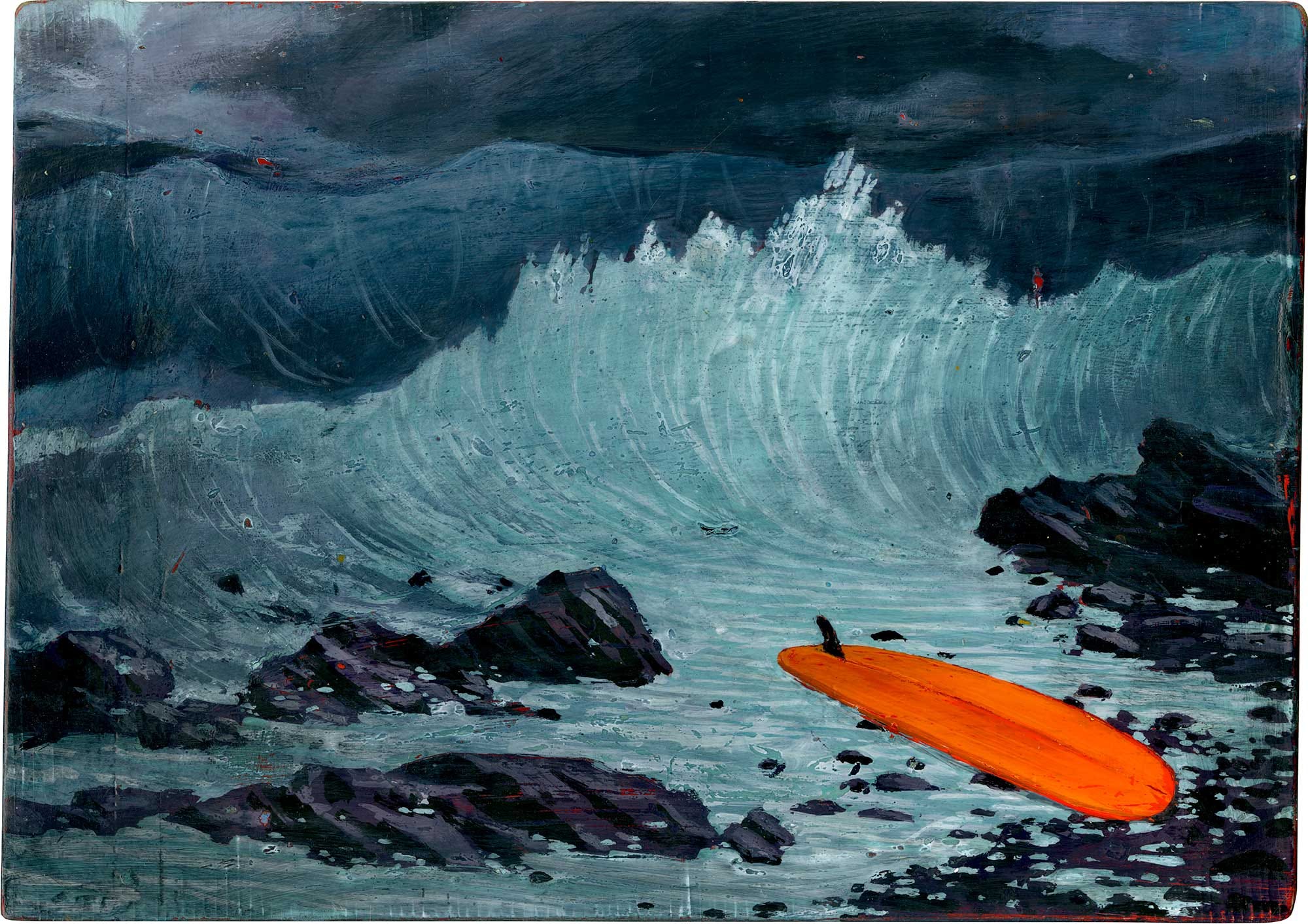
I put in the preceding paragraph for context (and because it’s so fun.) But yes, Mr. TRANG… my nemesis and friend… saw something in what I was intentionally trying to accomplish with this book. While writing it, I had a long convo with a writer and thinker I admire. I talked about feeling so much rage with the state of the world, and yet I was afraid to put that into my work.
He asked, “Why?” (Or better, why not?)
The old fear of being accused of sending messages, and lord above, being DIDACTIC (hey, look it up), was still haunting my brain package. Thankfully, I said fuck it. And Sayulita contains some of my favourite passages in all the Fischer books.
Like this one…
Sayulita Sucker
There was still no one in the alley, but with the sound of the shots, I guessed I wouldn’t be alone for long. My walk through the pass-through turned into a jog. It wasn’t like I had a single plan in my head, but an engine had fired up within me. I knew what it was—the one that always chugged deep below the surface. Since my days of beating heads in parking lot fights or hammering sparring partners in Montreal, I’d been able to suppress the thrum, even push it deeper. It was the sleeping giant, not snoring, sawing metaphorical logs, but dormant. Inactive. Seeing the goon about to kill the dog, it awoke. The giant had a name. Rage.
I quickened my pace coming out of the pass-through, scanning left and right. A few people were scattered on the street. Three smoked cigarettes and talked to each other in spurts of fast Spanish. A woman carried a basket of oranges, maybe freshly picked, their dark green leaves a stark contrast with the pile of almost-red fruit. I peeled past her, not even bothering to put away the gun I still held. The engine pushed away all my mental faculties, forcing them into one arrow of purpose. Go back to the house. Stop whatever was happening there. No matter what, stop it from happening. Now.
Someone yelled in Spanish, probably directed toward me. I heard the words gringo and loco. I didn’t hear any footfalls behind me, and I didn’t bother to turn and look.
One more turn and I was back at the adobe house. The grilled windows were like black teeth against the peeling wall. The door on the porch closed with a bang. _____’s body was gone—a dark trail went in the direction of the house. Even as I sprinted, I made out these details in crystal clarity, my senses sharp, my brain dull, except for the drive of the engine. No time for thought, only purpose. It was time to lay it all out.
A goon came out the door he’d just gone in. His hand dipped in his jacket and brought out a snub-nose. I shot him in the chest. I pushed past his collapsed body, around a rusted bench, through the door, and into the house. The giant was on fire and let out a bellow that I barely recognized as my own voice.
Thanks for reading.
Please follow Ellie Leonard
Cheers.
Straight out political messaging in fiction annoys me. Didactic is a good word, getting hit on the head is another way of saying it, which usually goes with "being talked down to". That stuff isn't subtle. I wrote a science-fiction tetralogy (that's 4 books, Craig, lol!) around the slipping/sliding of a democracy into dictatorship. It's a wild ride and tons of fun (to read AND write). Maybe I should re-issue the thing ... it's so on the nose right now that it hurts.
Do you find it difficult to writer a character with beliefs opposite to yours. It must be hard to get in that mindset to make it believable and not supercicial.